Nano-Glo® Fluorofurimazine In Vivo Substrate (FFz)
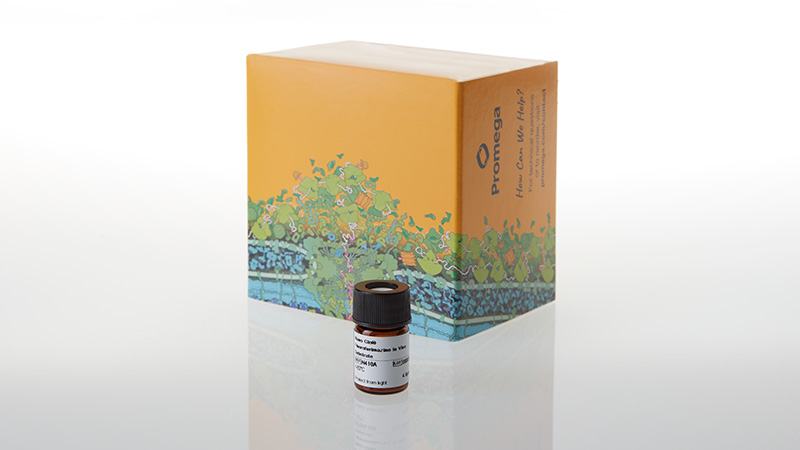
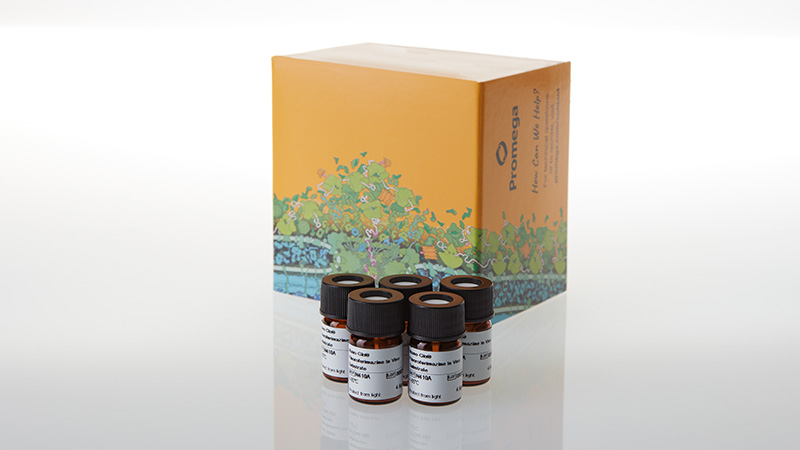
NanoLuc® and NanoBiT® Luciferase Substrate for Animal Imaging Studies
- Increased aqueous solubility allows increased substrate delivery
- Brighter in vivo signal
- Greater flexibility in delivery options
- Increased signal stability

Catalog Number:
Size
Catalog Number: N4100
Catalog Number: N4110
Reagent Optimized for in vivo Detection
NanoLuc® luciferase provides a new reporter option for advanced in vivo imaging applications. Its small size is ideal for engineering into compact genomes, and ATP-independence allows in vivo monitoring of both intracellular and extracellular events. Substrate specificity makes NanoLuc® luciferase an ideal complementary reporter to firefly luciferase for an improved dual-luciferase in vivo imaging solution.
The Nano-Glo® Fluorofurimazine In Vivo Substrate (FFz) is an optimized reagent designed specifically for in vivo detection of NanoLuc® luciferase, NanoLuc® fusion proteins or reconstituted NanoBiT® luciferase. This optimized, aqueous-soluble, in vivo detection reagent provides increased substrate bioavailability for bright, stable signals and offers flexible delivery options with handling requirements compatible with in vivo workflows.
Ideal for in vivo analysis of:
- Dual-reporter imaging with firefly luciferase
- Viral distribution
- CAR T-cell tracking
- Exosome/extracellular vesicles
- Optogenetics
- BRET-based reporters for enhanced deep-tissue imaging
Flexible Substrate Delivery
The Nano-Glo® Fluorofurimazine In Vivo Substrate can be delivered via multiple routes of administration. Each method offers different signal intensity and kinetics, allowing flexibility between experimental systems.
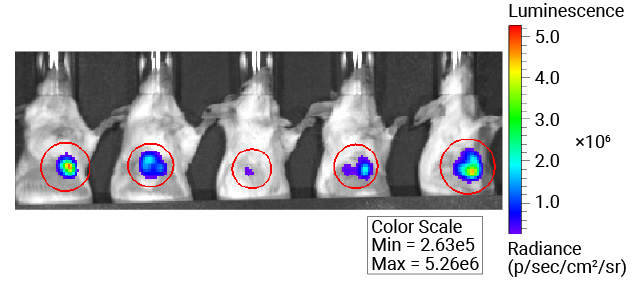
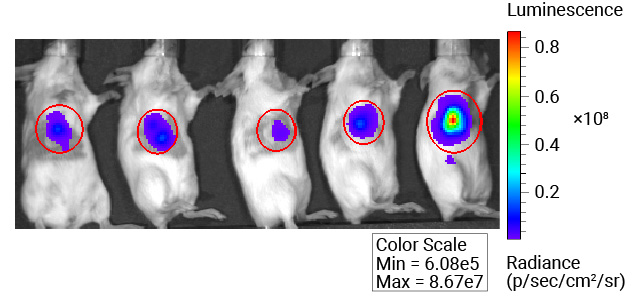
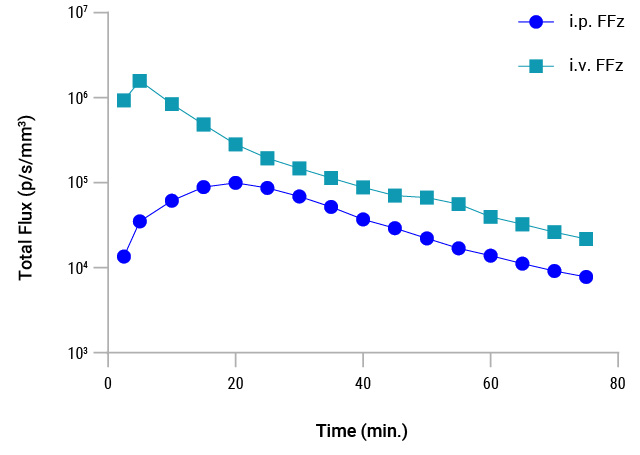
NanoLuc® signal of 4T1 primary tumors in BALB/c mice. Cells expressing NanoLuc® luciferase were orthotopically implanted into the #3 mammary fat pad of female BALB/c mice, and tumors were allowed to grow for 22 days. Mice were injected with FFz via i.p. (top image; circles) or i.v. injection (bottom image; squares). Bioluminescence imaging was done at the University of Wisconsin Small Animal Imaging and Radiotherapy Facility.
Ideal for Cell and Gene Therapy Applications
The small size of NanoLuc® luciferase makes it easy to package into viral genomes, allowing you to track tissue penetration of your virus for infectious disease or gene therapy applications.
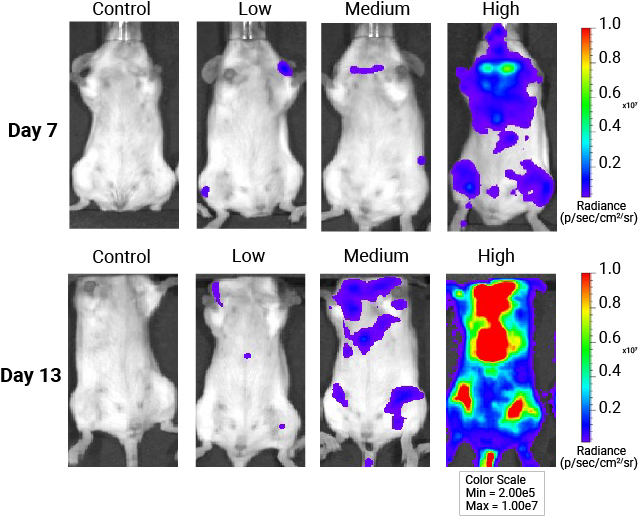
In vivo whole-body imaging of mice injected with AAV9-NanoLuc®-HaloTag® viral particles. Mice were injected with increasing levels of AAV9-NanoLuc®-HaloTag® viral particles. Nano-Glo® FFz (0.44μmol) was injected 7- and 13-days post-transduction followed by in vivo imaging. Tissue tropism starts to appear at 7 days, and a stronger signal and more extensive tissue tropism is visible after 13 days. Bioluminescence imaging was done at the University of Wisconsin Small Animal Imaging and Radiotherapy Facility.
Image the Brain of Living Animals with NanoLuc® Luciferase
Nano-Glo® Cephalofurimazine (CFz9) In Vivo Substrate enables the detection of NanoLuc® Luciferase in the brain of living animals. CFz9 was designed to cross the blood-brain barrier, enabling noninvasive exploration of central nervous system physiology and anatomy and studies of therapeutic distribution to the brain.
Learn more about the CFz9 substrate in this webinar.
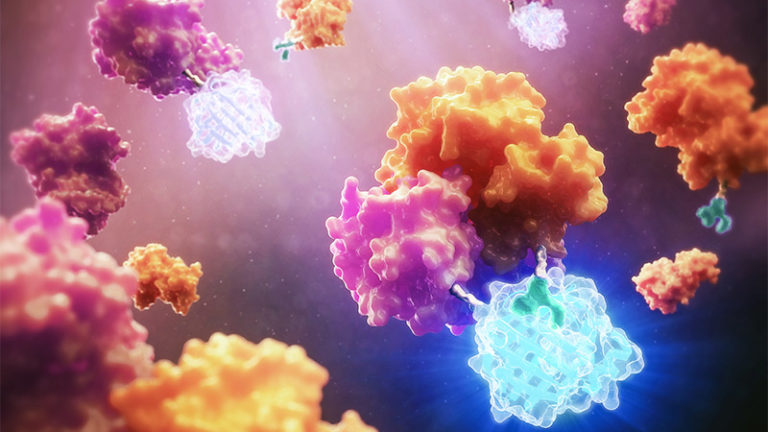
Learn More About Imaging with NanoLuc® Luciferase
NanoLuc® reporters can be multiplexed with firefly reporters to enable two-population bioluminescent imaging in animals. This publication used a NanoLuc® reporter to track tumor size and a firefly substrate to visualize CAR-T cells in the same animal over multiple days:
Novel NanoLuc® substrates enable bright two-population bioluminescence imaging in animals
(Su, Y. et al. (2020) Nature Methods 17, 852–860.)
Nano-Glo® Fluorofurimazine In Vivo Substrate (FFz) Citations by Application
Expand the section below to see a list of articles citing use of the Nano-Glo® Fluorofurimazine In Vivo Substrate in a variety of applications.
Search citations
Protocols
Specifications
Catalog Number:
What's in the box?
| Item | Part # | Size |
|---|---|---|
Nano-Glo® Fluorofurimazine In Vivo Substrate |
N410A | 1 × 4.6μmol |
SDS
Search for SDSCertificate of Analysis
Use Restrictions
For Research Use Only. Not for Use in Diagnostic Procedures.Storage Conditions
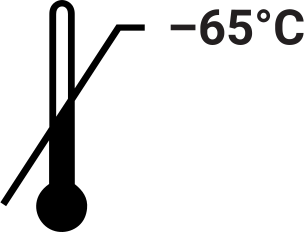
Nano-Glo® Fluorofurimazine in vivo Substrate Limited Used Label License
BY USE OF THIS PRODUCT, RESEARCHER AGREES TO BE BOUND BY THE TERMS OF THIS LIMITED USE LABEL LICENSE. If researcher is not willing to accept the terms of this label license, and the product is unused, Promega will accept return of the unused product and provide researcher with a full refund.
Researchers may use this product for research use only, limited to animal imaging experiments or experiments performed to prepare for such animal imaging experiments; no commercial use is allowed. “Commercial use” means any and all uses of this product by a party in exchange for consideration, including, but not limited to (1) use in further product manufacture; and (2) resale of the product, whether or not such product is resold for use in research. Researchers shall have no right to modify or otherwise create variations of the product. No other use or transfer of this product is authorized without the prior express written consent of Promega. Notwithstanding the foregoing, researcher may use this product in provision of services, information or data to third parties in exchange for consideration, provided that researcher does not transfer the product.
For uses of Nano-Glo®-branded reagents intended for energy transfer (such as bioluminescence resonance energy transfer) to acceptors other than a genetically encoded autofluorescent protein, researchers must:
(a) use NanoBRET®-branded energy acceptors (e.g., BRET-optimized HaloTag® ligands) for all determinations of energy transfer activity by this product; or
(b) contact Promega to obtain a license for use of the product for energy transfer assays to energy acceptors not manufactured by Promega.
With respect to any uses outside this label license, including any diagnostic, therapeutic, prophylactic or commercial uses, please contact Promega for supply and licensing information. PROMEGA MAKES NO REPRESENTATIONS OR WARRANTIES OF ANY KIND, EITHER EXPRESSED OR IMPLIED, INCLUDING FOR MERCHANTABILITY OR FITNESS FOR A PARTICULAR PURPOSE, WITH REGARD TO THE PRODUCT. The terms of this label license shall be governed under the laws of the State of Wisconsin, USA.
U.S. Pat. No. 11,691,976; Japanese Pat. No. 765351; and other patents pending.
What's in the box?
| Item | Part # | Size |
|---|---|---|
Nano-Glo® Fluorofurimazine In Vivo Substrate |
N410A | 5 × 4.6μmol |
SDS
Search for SDSCertificate of Analysis
Use Restrictions
For Research Use Only. Not for Use in Diagnostic Procedures.Storage Conditions
Nano-Glo® Fluorofurimazine in vivo Substrate Limited Used Label License
BY USE OF THIS PRODUCT, RESEARCHER AGREES TO BE BOUND BY THE TERMS OF THIS LIMITED USE LABEL LICENSE. If researcher is not willing to accept the terms of this label license, and the product is unused, Promega will accept return of the unused product and provide researcher with a full refund.
Researchers may use this product for research use only, limited to animal imaging experiments or experiments performed to prepare for such animal imaging experiments; no commercial use is allowed. “Commercial use” means any and all uses of this product by a party in exchange for consideration, including, but not limited to (1) use in further product manufacture; and (2) resale of the product, whether or not such product is resold for use in research. Researchers shall have no right to modify or otherwise create variations of the product. No other use or transfer of this product is authorized without the prior express written consent of Promega. Notwithstanding the foregoing, researcher may use this product in provision of services, information or data to third parties in exchange for consideration, provided that researcher does not transfer the product.
For uses of Nano-Glo®-branded reagents intended for energy transfer (such as bioluminescence resonance energy transfer) to acceptors other than a genetically encoded autofluorescent protein, researchers must:
(a) use NanoBRET®-branded energy acceptors (e.g., BRET-optimized HaloTag® ligands) for all determinations of energy transfer activity by this product; or
(b) contact Promega to obtain a license for use of the product for energy transfer assays to energy acceptors not manufactured by Promega.
With respect to any uses outside this label license, including any diagnostic, therapeutic, prophylactic or commercial uses, please contact Promega for supply and licensing information. PROMEGA MAKES NO REPRESENTATIONS OR WARRANTIES OF ANY KIND, EITHER EXPRESSED OR IMPLIED, INCLUDING FOR MERCHANTABILITY OR FITNESS FOR A PARTICULAR PURPOSE, WITH REGARD TO THE PRODUCT. The terms of this label license shall be governed under the laws of the State of Wisconsin, USA.
U.S. Pat. No. 11,691,976; Japanese Pat. No. 765351; and other patents pending.
Resources
Articles
- Paper: Evaluation of NanoLuc® Substrates for Bioluminescence Imaging of Transferred Cells in Mice
- Paper: Optogenetic Control of Non-Apoptotic Cell Death
- Paper: Heterologous Reporter Expression in the Planarian Schmidtea mediterranea through Somatic mRNA Transfection
- Using genetically modified extracellular vesicles as a non-invasive strategy to evaluate brain-specific cargo
- Enhancing anti-EGFRvIII CAR T cell therapy against glioblastoma with a paracrine SIRPγ-derived CD47 blocker
- This study sought to the effect of branched chemically modified poly(A) tails on enhancing mRNA stability and translation capacity.