RealTime-Glo™ Annexin V Apoptosis and Necrosis Assay


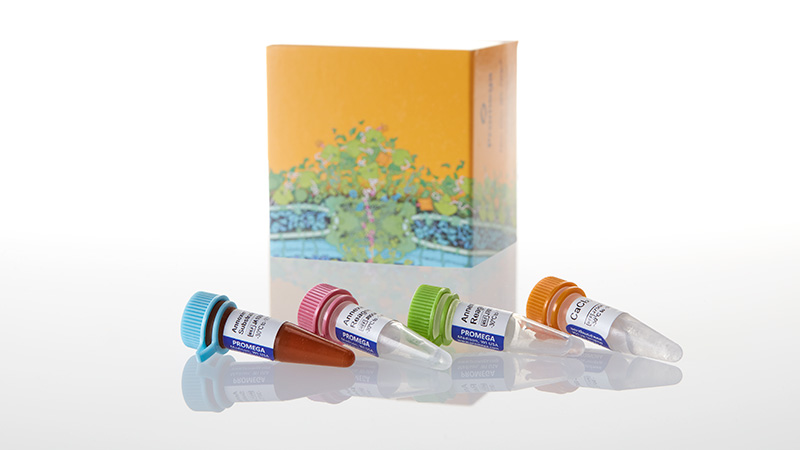

Simple, Plate-Based Assay for Real-Time Apoptosis Detection
- No-wash, one-step Annexin V assay
- Non-lytic; allows continual monitoring of cell state to determine apoptotic onset
- Scalable for high-throughput screening applications

Catalog Number:
Choose an assay
Size
Catalog Number: JA1011
Catalog Number: JA1012
Catalog Number: JA1000
Catalog Number: JA1001
Real-Time Monitoring of Apoptosis Progression
The RealTime-Glo™ Annexin V Apoptosis and Necrosis Assay measures the real-time exposure of phosphatidylserine (PS) on the outer leaflet of cell membranes during the apoptotic process. Annexin V luciferase fusion proteins supplied in the assay reagent bind to PS during early apoptosis and are detected with a simple luminescence signal. The assay reagent also includes a DNA-binding dye, which enters the cell and generates a fluorescent signal upon loss of membrane integrity.
The combination and timing of luminescent (annexin V binding) and fluorescent (DNA release) signals is used to differentiate secondary necrosis occurring during late apoptosis from necrosis caused by other cytotoxic events.
The RealTime-Glo™ Annexin V Apoptosis and Necrosis assay is non-lytic and the simple “add-and-read” method allows multiple readings from a single assay well. Apoptosis can be monitored in real time, without the need for multiple plates, complicated processing, or specialized detection equipment. A multimode reader capable of detecting luminescence and fluorescence is the only instrument required.
How the Annexin V Assay Works
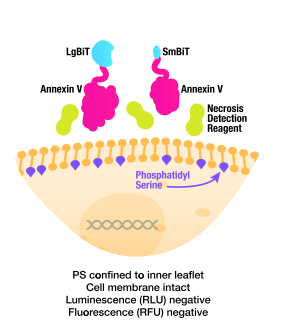
Based on NanoLuc® Binary Technology (NanoBiT), the RealTime-Glo™ Annexin V Apoptosis Assay uses Annexin V fusion proteins containing complementary subunits of NanoBiT® luciferase (Annexin V-LgBiT and Annexin V-SmBiT). When in close proximity, the LgBiT and SmBiT subunits come together to form a functional luciferase.
Healthy Cell
The Detection Reagent contains Annexin V-LgBiT and Annexin V-SmBiT (NanoBiT) fusion proteins and a profluorescent DNA dye.
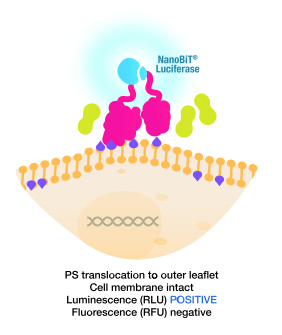
Early Apoptosis
Luminescence remains low until PS exposure brings the Annexin V fusion proteins close together, forming a functional luciferase.
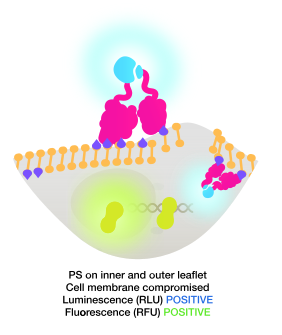
Secondary Necrosis
A fluorescent signal is generated upon loss of membrane integrity during late stage apoptosis, when the DNA dye can enter the cell.
What the Data Looks Like, Literally
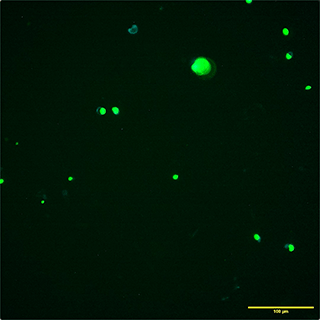
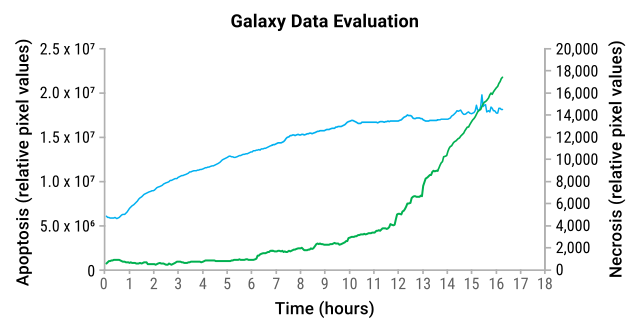
Measurement of Annexin V binding (luminescence) and loss of membrane integrity (fluorescence) repeatedly from the same sample well after exposure to a test compound allows resolution of the effects of cytotoxic stimuli and determination of mechanism of action. Here, the time delay between the emergence of phosphatidylserine : Annexin V binding and the loss of membrane integrity indicates an apoptotic phenotype that leads to secondary necrosis. Video and data captured using the GloMax® Galaxy Bioluminescence Imager.
Add One Reagent, Read Repeatedly
Different Doses, Multiple Time Points, One Assay Plate
With this real-time Annexin V assay, repeated measures of luminescence and fluorescence from the same well during compound exposure allow determination of compound potency using far fewer plates and less reagents than endpoint assays.
The reagent is well tolerated by a variety of cultured cell types and can be applied prior to treatment or at dosing for real-time measurement of the dose and time-dependent magnitude of apoptotic progression.
RealTime-Glo™ Apoptosis Assay
Multiple data points. One reagent addition. One assay plate.
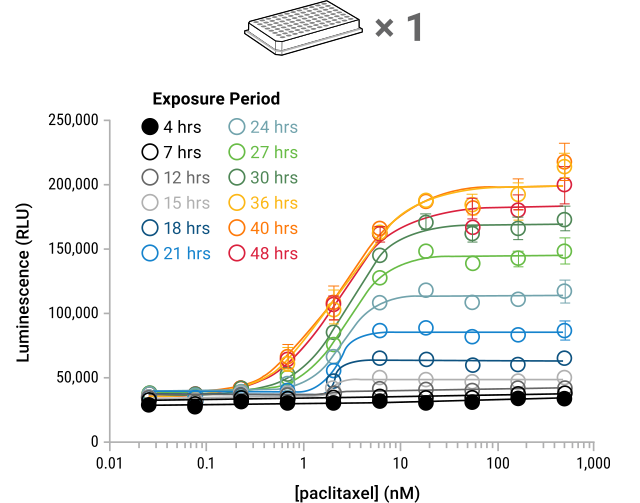
Data for each dose was obtained at multiple time points using a single assay plate with one reagent addition.
Endpoint Assay
Multiple data points. Multiple assay plates.
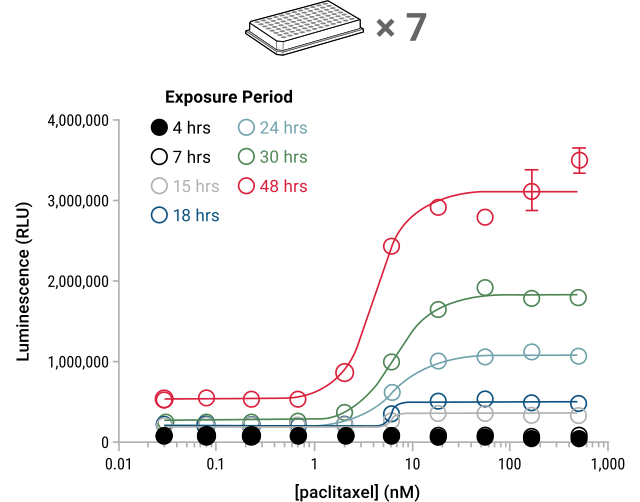
Here, 7 plates were needed to obtain the data that could be achieved using a single plate with the real-time assay.
See More Data: Learn more about this data and see how the RealTime-Glo™ Annexin V Apoptosis Assay can be used with various cell models exploring safety and exposure in the poster A Real-Time, Bioluminescent Annexin V Assay for the Assessment of Apoptosis, presented at SOT 2017.
Results are consistent with those from fluorescent annexin binding methods detected by flow cytometry.
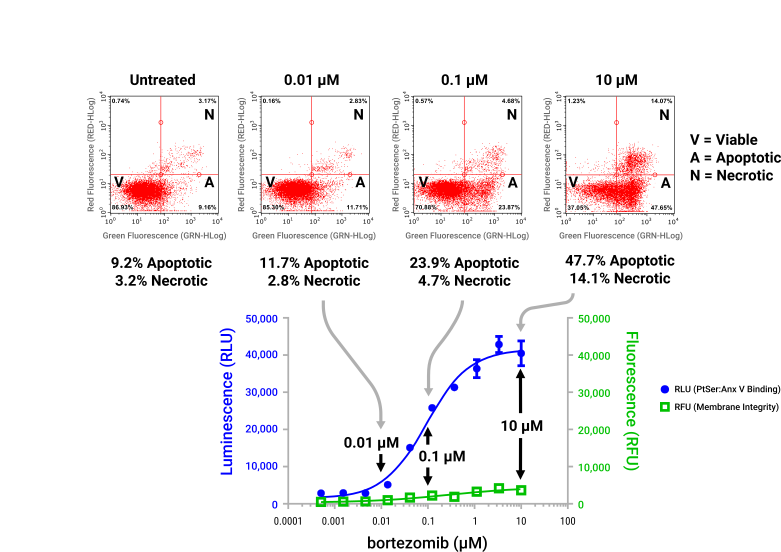
In this experiment, K562 cells were exposed to various doses of bortezomib for 16 hours.
Top Panel: Cells were harvested, washed and labeled with Alexa Fluor® 488 (green fluorescence, phosphatidylserine:Annexin V binding) and 7-AAD (red fluorescence, membrane integrity) and analyzed by flow cytometry (10,000 events).
Bottom Panel: K562 cells (10,000/well) were exposed to serial dilutions of bortezomib in the presence of the RealTime-Glo™ Annexin V Apoptosis Assay reagent. Luminescence (phosphatidylserine:Annexin V binding) and fluorescence (membrane integrity) were recorded kinetically. The 16-hour incubation with bortezomib is shown.
See More Data: Additional data illustrating how the real time method can be used to differentiate modes of cell death is available in the Poster A Real-Time, Plate -based Annexin V Method for Monitoring Programmed Cell Death, presented at AACR 2017.
Available With or Without Necrosis Detection Reagent
RealTime-Glo™ Annexin V Apoptosis and Necrosis Assay
(Cat.# JA1011 and JA1012)
Includes Necrosis Detection Reagent, a cell-impermeant profluorescent DNA dye. Upon loss of membrane integrity, the dye enters the cell and binds to DNA, generating a fluorescent signal.
RealTime-Glo™ Annexin V Apoptosis Assay
(Cat.# JA1000 and JA1001)
Does not include Necrosis Detection Reagent. Although the assay can be conducted without a necrosis detection probe, the mechanism of action of PS exposure will not be revealed. Therefore, when using Cat.# JA1000 or JA1001, we recommend incorporating an asymmetric cyanine dye such as CellTox™ Green (Cat.# G8742) or structurally related molecules, for full assay functionality and data clarity.
Customer Testimonial
Challenge:
Grant Harradence, manager of the Bioassay Department at Abzena, oversees successful implementation of cytotoxicity assays to identify promising lead candidates. He and his team needed more data per assay to better understand bioconjugates mode of action and kinetics. End-point assays were too limiting and time-consuming.
Result:
The team integrated RealTime-Glo™ Annexin V Apoptosis Assay to their workflow with no challenging optimizations, and were able to capture more information with fewer assays.
Their workflow also includes CellTiter-Glo® Luminescent Cell Viability Assay for cell viability. The expanded data available to their clients and partners has helped them strengthen their collaborative research relationships.

Protocols
Specifications
Catalog Number:
What's in the box?
| Item | Part # | Size |
|---|---|---|
Annexin V-SmBiT Reagent (1,000X) |
J700A | 1 × 25μl |
CaCl2 (1,000X) |
J750A | 1 × 250μl |
Annexin V-LgBiT Reagent (1,000X) |
J800A | 1 × 25μl |
Annexin V NanoBiT® Substrate, 1,000X |
JA100A | 1 × 25μl |
Necrosis Detection Reagent, 1,000X |
JA101A | 1 × 25μl |
SDS
Search for SDSCertificate of Analysis
Use Restrictions
For Research Use Only. Not for Use in Diagnostic Procedures.Storage Conditions
U.S. Pat. No. 8,809,529, European Pat. No. 2635582, Japanese Pat. No. 5889910 and other patents and patents pending.
U.S. Pat. Nos. 8,598,198 and 9,458,499 and other patents and patents pending.
U.S. Pat. Nos. 9,797,889, 9,797,890 and 11,493,504; European Pat. No. 2970412; Japanese Pat. Nos. 7280842 and 7532562; and other patents pending.
What's in the box?
| Item | Part # | Size |
|---|---|---|
Annexin V-SmBiT Reagent (1,000X) |
J700B | 1 × 250μl |
CaCl2 (1,000X) |
J750A | 1 × 250μl |
Annexin V-LgBiT Reagent (1,000X) |
J800B | 1 × 250μl |
Annexin V NanoBiT® Substrate, 1,000X |
JA100B | 1 × 250μl |
Necrosis Detection Reagent, 1,000X |
JA101B | 1 × 250μl |
SDS
Search for SDSCertificate of Analysis
Use Restrictions
For Research Use Only. Not for Use in Diagnostic Procedures.Storage Conditions
U.S. Pat. No. 8,809,529, European Pat. No. 2635582, Japanese Pat. No. 5889910 and other patents and patents pending.
U.S. Pat. Nos. 8,598,198 and 9,458,499 and other patents and patents pending.
U.S. Pat. Nos. 9,797,889, 9,797,890 and 11,493,504; European Pat. No. 2970412; Japanese Pat. Nos. 7280842 and 7532562; and other patents pending.
What's in the box?
| Item | Part # | Size |
|---|---|---|
Annexin V-SmBiT Reagent (1,000X) |
J700A | 1 × 25μl |
CaCl2 (1,000X) |
J750A | 1 × 250μl |
Annexin V-LgBiT Reagent (1,000X) |
J800A | 1 × 25μl |
Annexin V NanoBiT® Substrate, 1,000X |
JA100A | 1 × 25μl |
SDS
Search for SDSCertificate of Analysis
Use Restrictions
For Research Use Only. Not for Use in Diagnostic Procedures.Storage Conditions
U.S. Pat. No. 8,809,529, European Pat. No. 2635582, Japanese Pat. No. 5889910 and other patents and patents pending.
U.S. Pat. Nos. 9,797,889, 9,797,890 and 11,493,504; European Pat. No. 2970412; Japanese Pat. Nos. 7280842 and 7532562; and other patents pending.
What's in the box?
| Item | Part # | Size |
|---|---|---|
Annexin V-SmBiT Reagent (1,000X) |
J700B | 1 × 250μl |
CaCl2 (1,000X) |
J750A | 1 × 250μl |
Annexin V-LgBiT Reagent (1,000X) |
J800B | 1 × 250μl |
Annexin V NanoBiT® Substrate, 1,000X |
JA100B | 1 × 250μl |
SDS
Search for SDSCertificate of Analysis
Use Restrictions
For Research Use Only. Not for Use in Diagnostic Procedures.Storage Conditions
U.S. Pat. No. 8,809,529, European Pat. No. 2635582, Japanese Pat. No. 5889910 and other patents and patents pending.
U.S. Pat. Nos. 9,797,889, 9,797,890 and 11,493,504; European Pat. No. 2970412; Japanese Pat. Nos. 7280842 and 7532562; and other patents pending.
Resources
Related Products
Similar Products
RealTime-Glo™ MT Cell Viability Assay
A bioluminescent method to kinetically monitor viability in cell culture up to 72 hours.
G9711, G9712, G9713
CellTox™ Green Cytotoxicity Assay
Measures changes in membrane integrity. Kinetically monitors cytotoxicity up to 72 hours with multiplex capability.
G8741, G8742, G8743, G8731
NanoBiT® PPI Starter Systems
Complementation reporter for detection of protein interactions in live cells.
N2014, N2015, N2016
Frequently Used With
Caspase-Glo® 3/7 Assay System
An easy-to-use, plate-based luminescent assay for detecting caspase-3/7 activity.
G8090, G8091, G8093, G8092
CellTiter-Fluor™ Cell Viability Assay
A non-lytic, fluorescent cell viability assay with multiplex capability.
G6080, G6081, G6082
CellTiter-Glo® 2.0 Cell Viability Assay
Updated CellTiter-Glo® Cell Viability Assay with improved reagent stability. Quantifies cell proliferation based on ATP detection.
G9241, G9242, G9243
Caspase-Glo® 9 Assay Systems
Measure caspase-9 activity with this homogeneous, luminescent assay.
G8210, G8211, G8212